Maravedis Research
PropTech Evolution in U.S. Multifamily
Couldn't load pickup availability
About the Report
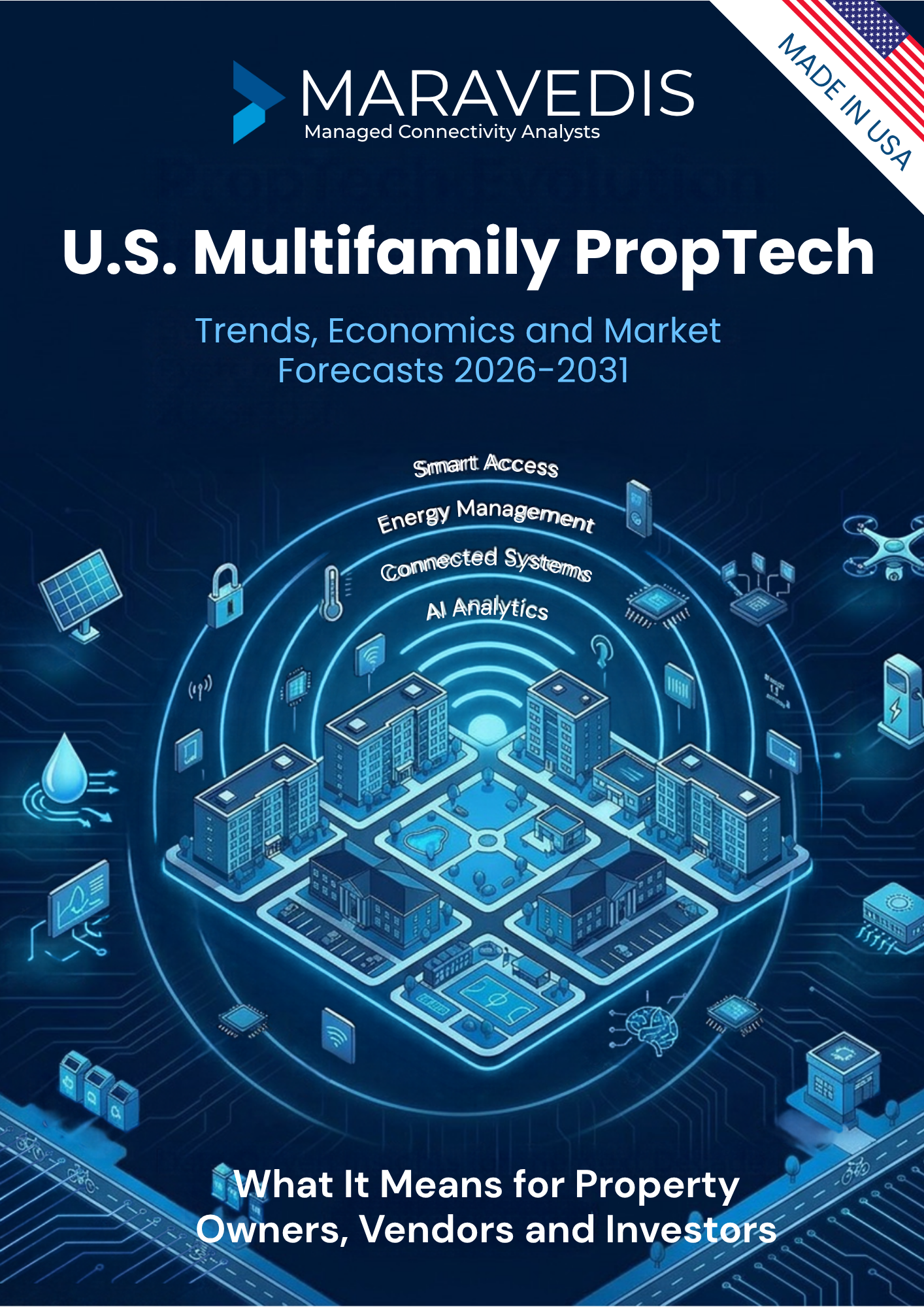
PropTech Evolution in U.S. Multifamily: Building Intelligence, Connected Systems & Market Outlook 2026–2031 maps the structural shift underway in U.S. multifamily, from fragmented smart-apartment point solutions to integrated building intelligence platforms that unify managed Wi-Fi, access control, HVAC and energy, IoT sensors, and AI-driven resident services. Published by Maravedis, the report covers the full PropTech stack: connectivity foundations and MSP business models, partnership and ecosystem dynamics, access control, HVAC and sustainability, smart unit platforms and interoperability (Matter, BACnet, MQTT), value-added services and AI, competitive landscape, and segment-level market forecasts through 2031. Vendor assessments use the proprietary Maravedis Market Score™ framework, applied independently with no sponsored placements or pay-to-play rankings. Built for MSPs, WLAN vendors, PropTech platform providers, property owners and operators, and investors, the report combines primary interviews with vendors, integrators, and operators with secondary data triangulation and Maravedis's proprietary forecast models.
Executive Summary
Key findings, market sizing, and strategic implications for MSPs, WLAN vendors, property owners, and PropTech platforms.
1. Introduction and Market Overview
- Report objectives, methodology, and scope
- U.S. multifamily market context: stock, renter demographics, property class segmentation
- PropTech investment trends: VC, PE, and M&A activity 2022–2025
- Key drivers: NOI pressure, resident expectations, ESG mandates, insurance incentives
- Key inhibitors: fragmentation, capital constraints, retrofit complexity
- The shift from smart home to building intelligence: a platform model emerges
2. The Connectivity Foundation
- Bulk managed Wi-Fi as the enabling layer for all PropTech systems
- MDU broadband models: bulk retail, MSP-managed, operator-deployed
- Wi-Fi 6/6E/7 adoption roadmap; in-building cellular
3. Partnership Models and Ecosystem Dynamics
Why no single vendor wins MDU deals alone, and how integrator, connectivity, and platform partnerships are reshaping go-to-market in multifamily.
- The partnership imperative: why MDU deals require complementary relationship capital, technical expertise, and platform integration
- Taxonomy of MDU partnership archetypes: technology OEM, platform integrator, channel reseller, co-sell alliance, and ecosystem orchestrator
- The integrator model: smart property platforms as go-to-market bridges between CSPs/MSPs and multifamily developers
- Developer relationship capital: how integrators unlock family office and institutional property owner networks inaccessible through direct sales
- Case example: GreenMarbles HomeLink + Zentro + Calix SmartMDU™ — a tripartite model delivering managed Wi-Fi, smart home, and building automation within a single framework
- Lead-flow dynamics: when the opportunity originates with the integrator vs. the service provider, and how deal economics are structured accordingly
- Platform-as-ecosystem: defining roles and responsibilities across integrators, connectivity providers, and smart building vendors in a multi-party deployment
- Formal vs. informal partnership structures: referral arrangements, co-selling agreements, revenue sharing, and embedded platform integrations
- Building a partnership program: incentive structures, deal registration, co-marketing, and partner enablement
- Measuring partnership effectiveness: deal velocity, property win rates, revenue attribution, and partner churn
- Risks and failure modes: vendor lock-in, accountability gaps, partner conflict, and integration fragility in multi-vendor deployments
- Emerging partnership categories: insurance providers, utilities, real estate platforms, and telecom consultants as ecosystem entrants
- The future of MDU partnerships: platform consolidation, white-label arrangements, and the move toward single-contract smart community delivery
4. Access Control
- Evolution from key fob to cloud-based smart access
- Architecture: intercoms, smart locks, package management, visitor management
- Common area vs. unit-level deployment; retrofit economics– Integration with property management systems
- Key vendors: Quext, Latch, Allegion, dormakaba, LiftMaster
- Maravedis Market Score™: access control vendor assessment
5. HVAC, Energy, and Sustainability
- Smart thermostats and HVAC control: highest-impact smart unit system
- Demand response and grid flexibility programs in multifamily
- Submetering, utility billing, and energy analytics platforms
- Solar, battery storage, and EV charging integration
- Smart water management and leak detection
- Regulatory landscape: decarbonization mandates, local law compliance
- Key vendors: Honeywell, ecobee, Verdant, WattTime, RealPage Energy, Urjanet
6. IoT Building Systems and Smart Units
- BMS vs. IoT platform overlays: common area sensors, predictive maintenance, fire/life safety
- The connected apartment bundle: locks, thermostats, lighting, leak sensors
- Self-guided tours, move-in ready connectivity, and the turnkey resident experience
- Retrofit cost per door, payback periods, and rent premium uplift
- Interoperability standards: Matter, BACnet, MQTT, API ecosystems
- Key platforms: SmartRent, iApartments, Quext, Alfred, Alertify
- Maravedis Market Score™: smart unit platform assessment
7. Value-Added Services, Resident Experience, and AI
- Resident apps: amenity booking, package management, concierge, reputation management
- AI-powered leasing and maintenance automation
- Lifestyle and financial services: renters insurance, identity verification, super-app ambitions
- Senior living applications: remote monitoring, wellness, ambient sensing
- Data unification, predictive analytics, and NOI optimization
- Privacy and data governance in connected MDUs
- Key platforms: ElevateOS, EliseAI, Cherre, Zego, Funnel, RealPage, Yardi
8. Competitive Landscape and Go-to-Market Dynamics
- Vendor map by system category
- Platform consolidation trends: acquisition activity and integration strategies
- Standalone vs. integrated platform plays
- Telecom consultants as channel influencers in vendor selection
- MSPs as PropTech distribution channel
- Property owner decision-making: asset managers vs. property managers vs. IT
9. Market Forecasts and Strategic Recommendations
- Market sizing by segment: access control, HVAC/energy, IoT, smart unit, VAS (2026–2031)
- Adoption curve projections by property class and geography
- Revenue opportunity by channel
- Recommendations for MSPs, WLAN vendors, property owners, and PropTech platforms
Appendices
- A: Vendor directory
- B: Glossary
- C: Methodology and data sources
- D: Maravedis Market Score™ framework and scoring criteria